Tuesday, May 01, 2007

How To Confuse a Canadian

It's all so GREEN!

It's fall in New Zealand. At least that's what they tell me. The days are getting shorter and cooler. It's raining more often. My sweaters are coming out of hiding. There's fall stuff going on.

And yet, to me, it sure doesn't look like fall! Growing up in Canada, there was just no mistaking it. When fall came around, the trees changed into fabulous shades of yellow and red! Then, slowly, winter's approach blew those leaves from their stalks leaving the skeletal branches bare until spring.

Down on the South Island, rumour has it that this kind of fall ritual also takes place. But up here in Wellington there is not a crimson leaf in sight. Not in the city, not in the bush. And to me, it's just not fall. I came here prepared for the snowless winters (except in the mountains) but nobody warned me about the green trees of autumn! I'm a four seasons kinda gal, I like visual cues to back up what the calendar says.

I'm adjusting pretty well to my new life Down Under, but every once in a while something like this sneaks up and reminds me that life is different. Fall is when spring used to be, and it doesn't look like it's supposed to. Perhaps I need a trip to the South Island!

Monday, April 23, 2007

The Dreaded Poison Pen

I came across this cute list of things to do with negative reviews. While Sex in a Tent hasn't been reviewed yet (or printed for that matter!) it's good to have these on standby just in case. I will definitely skip #5 though--even the worst review is no reason to kick a puppy!

Bargain Books & Author's Guilt

Yesterday I was rummaging through my local Warehouse store (for you non-Kiwis that's a discount store like K-Mart or Target) and picked up a book in the "bargain books" bin. It's called Outdoors in New Zealand and it's a compilation of columns published in the New Zealand Herald's "Outdoors" column over a number of years. I'd seen it in a few bookshops, but never bothered to pick it up. But at $2.50, how could I refuse?

Clearly the book has been remaindered. If you're not familiar with the term, that's when a publisher decides that the cost of storing the remaining copies of the book is no longer worthwhile and they unload them at a very low price. Bookstores (and other stores) then sell them off at a fraction of their original cover price. This often happens after the book has been out for a couple of years and sales have dropped off. In the case of the book I just purchased, it's a 2002 publication.

I've picked up some great books from remainder bins. Even Pulitzer Prize-winning novels like The Shipping News! Just the other day I saw a copy of Charlie and the Chocolate Factory on a bargain table for $5, if you can believe it! My only explanation for that is there must be a new edition coming out and they're getting rid of the last copies with old cover art or something.

As a bargain-hunter, remaindered books really appeal to me. Especially since I arrived in New Zealand where the average book price is about 30-50% higher than it was in Canada. But now that I'm an author, every bargain purchase comes with a heavy serving of guilt. I know how hard it is to make a living as a writer, and how small a cut the author gets from every book sold. And that's if the book sells at its full cover price! Buying remaindered books means that the author won't get anything at all from my purchase. Oh, the guilt!

Of course, when it comes to the filthy-rich authors like Roald Dahl (or Stephen King, whose books I've also seen in bargain bins) I don't feel too bad. But books like Outdoors in New Zealand are lucky to break even, let alone make the author rich. As a fellow writer, I feel like I should be supporting my colleagues by paying full price for their books. On the other hand, that might mean not buying books in New Zealand at all!

It's a dilemma for me, and one that's not likely to go away any time soon. As much as it would pain me to see my own book sitting in a remainder bin for $2.50 one day, I know that it would be in good company. There's no shame in remaindering. Just ask Roald Dahl or Stephen King!

Monday, April 09, 2007

I've been walking on the railroad

There always seems to be a battle between those who would use the land for economic development, "progress" they like to call it, and those who struggle to preserve as much of nature as they can. Here in New Zealand, it's often a noisy struggle, particularly as property values increase and the temptation to develop the hell out of the country becomes harder to resist.

While the overriding trend is towards greater development of previously natural land, sometimes things work the other way. Land that once had an industrial use is no longer needed for that purpose, and is reclaimed as recreational land.

This has happened all over the world, particularly on waterfront land. As commercial ports become more efficient, they don't require as much space as they once did. Cities are turning their ugly ports into pleasant waterfront areas. It has happened in Toronto, San Francisco, and even here in Wellington.
One of the other places where this can happen is on disused railway lines. In many places where rail was once the only way to move goods (and people) the roads have improved to the point where it no longer makes sense to use trains. Or in the case of the Rimutaka pass here in Wellington, they replaced a winding, mountain pass with a more direct tunnel under the mountains.

So what was once the only way to get from the Hutt Valley to the Wairarapa over the Rimutaka mountains (from the 1870s to the 1950s), is now a pleasant walking track called the Rimutaka Rail Trail.

G and I took a walk there last weekend, since the weather was almost perfect for walking. We didn't cover the whole trail, because it's a five hour, one-way journey that would have left us on the wrong side of the mountains. Instead we walked from the Hutt side to the summit, and back again. It took six hours for the return journey.

Although it is an uphill walk (for the first half anyway), the gradient is so gradual that you hardly notice. The track is more like a gravel road, and there were more bicycles out than walkers. The remains of the railway history are marked by informational signs here and there, as well as a few physical reminders. There are a couple of tunnels, the summit tunnel is over 500 metres long and awfully dark inside! A restored bridge also retains its original feel, and some engine remains at the summit are rusting away in all their glory.
I can't really classify this as a hike, more like a very long stroll through a park. But it was nice to get outdoors on a beautiful fall day, and take advantage of a bit of Wellington's industrial history returned to its semi-natural splendour.

A Book By Any Other Name

Most people don't realise just how little power an author has over her own book. The assumption is that if you wrote it, you're in control of how it turns out. But that's just not true.

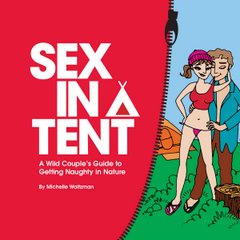
In fact, the publisher has the final say on just about everything, including the book's title. So after some market research and a bit of internal debate, my book has a new title. I am now the author of:

Sex in a Tent: A wild couple's guide to getting naughty in nature

It all goes to support the general consensus that sex sells! Which doesn't mean that any of the other great stuff in the book (avoiding or resolving arguments, planning the right kind of trip, romantic meals etc.) is going away. It just means the more provocative side of the book is front and centre. So don't be confused when you see the book under its new title.
And when will you be seeing it, you ask? It looks like the release will happen in October, in time to get it to the top of everyone's holiday wish list.

More release news will appear here as I get it. In the mean time I'm looking forward to the abundant joys of proofreading, which should come my way pretty soon.

The only question remaining is - now that my book title has changed, does the name of my blog still make sense?

Disappearing Huts and Other Mysteries

Planning a camping trip in New Zealand can be a challenge at the best of times. Weather conditions are notoriously hard to predict, and even the most accurate topographic maps don't always tell the whole story. So when G and I sat down to make plans for the Easter weekend, it seemed like a simple enough task--but of course it wasn't.

Our original plan involved a three day trip, staying at two huts in the western Tararuas. The route was a complete loop, which is always nice. One-way trips are a pain to organize, and you need to team up with others who have a car to shuttle. The only other option is to backtrack to your starting point, which means essentially doing the same hike twice.

Having chosen our potential route, I decided to check it out on the internet and see what others had to say about it. Enter problem number one.

One of the huts we'd seen on our map, and decided to stay in on our second night, no longer existed! It had been damaged in a 2003 storm, and removed by the Department of Conservation. The replacement hut hasn't been built yet. Well, there goes our plan!

I also learned that the riverside trail I was hoping to loop back along wasn't really a trail at all. For most of the time, you just follow the river any way that works. This means that if it rains the day before, you could be walking in the river all day--or worse, it could be impassible in places. Our plan was sounding worse and worse.

It was around this time that I convinced G to cut back the trip to two days, staying at the one hut on our route that was still standing, called Waiopehu Hut.

We headed out on Good Friday, in almost perfect weather. April can be pretty rough at times, but the day was shaping up to be sunny, warm and calm. The track was estimated to take 5 hours to reach the hut, and we set off at 10am to tackle our climb up the ridge.

About half way to the hut, according to our topo map, there was a shelter which had fallen on hard times. These emergency shelters are scattered around the mountains, offering some protection to trampers who get caught out in bad weather and can't make it to the next hut.

When I realised that at 2pm we still hadn't passed a shelter, I was more than a little concerned about the time estimate on the track. We are admittedly not very fast walkers, and we often take longer than the estimates to reach our destination. And after all, we hadn't been on a trip since early February. (Where does the time go?!) Still, if we weren't yet half way after 4 hours, we were looking at a long day!
Just after 3pm we reached a clearing and found a sign that said "Old Waiopehu Hut Site". I knew that the hut had been replaced recently, but I wasn't sure how far away they'd moved it. One thing was for sure--the shelter on the map didn't exist! And what about the Waiopehu Hut on our map? Was it showing the old location, where we were standing, or the new one? If the one on the map was the old one, how far away might the new one still be?

It was a relief to arrive at the hut less than half an hour later. And not only was it a shiny, new hut, but it had a spectacular view over the ridge. We could see across to the next ridge, where another track would lead us back to the beginning of the route the next day. We could also see down to the coastline to the west, where hot air balloons from a nearby balloon festival dotted the sky at dusk. (This picture is from slightly earlier, so no balloons.)

Inside the hut things were buzzing. Since it was a long weekend, the trampers were out in force, and in total there were 14 people sleeping at the hut that night. (True to form, I ended up sleeping next to the only one who snored!)

One of the other groups were locals who had done the other ridge track several years before. According to them, it was overgrown and hard to find in places, and deeply eroded in others. Our hike up had been quite reasonable, but after several weeks of sloth it had been tough enough for us. The longer, harder and possibly hard to follow route back didn't sound appealing at all! I made an executive decision (and G didn't fight it) that we would hike out on the same track we came up on. At least we'd know what we were in for that way.

The next day was another beautiful one. Still warm and calm, with the clouds gradually breaking up around noon. We may not have had too much adventure on our trip, but we had some wonderful views and great walking weather. Let's hope winter doesn't show up too soon.

Tuesday, April 03, 2007

The Honeymooners

I got an e-mail recently from a guy in the US who is planning to spend his honeymoon in New Zealand and wants to do some tramping with his new wife.

It's really great to hear people including camping in their holiday plans--especially honeymoon plans! For one thing, it assures me that there are lots of potential buyers out there for How to Make Love in a Tent. But it's also great when people are able to think outside the beach-resort box and use their honeymoon as an opportunity to have an adventure together.

I think that without a doubt exploring the fjords and forests of New Zealand, or the dizzying heights of the Himalayas, is a much more memorable way to begin a life together than lounging beside a pool with a rum punch in hand.

So for all of you thinking about your next vacation (I know I'm always thinking about mine!) I encourage you to pack your hiking boots and do something really memorable.

Do vacations get any more romantic than this?

No way!

Friday, March 23, 2007

Spice Things Up

I'm into cooking good food, and I don't see any reason for that to stop just because I happen to be in the middle of the woods. But one of the things that I have found a bit of a pain is bringing along a small quantity of spices for a backpacking trip.


The last thing I want to do is load up my backpack with a bunch of heavy, glass spice bottles. So what I sometimes do is pre-measure the herbs and spices for a specific meal and take them in a tiny plastic baggie. But that doesn't allow me to adjust the seasoning at all.


What I really wanted was a way to bring along a selection of herbs and spices in a lightweight, spill-free container. And here's my solution--a multi-compartment pill box!


Pill boxes have small, separate compartments so you can bring along a variety of spices and keep them separate. I had to do a bit of looking around to find ones that seal well on the top. Since pills are quite large, sometimes the makers of plastic pill boxes don't care if their lids leave gaps, but for spice that would mean they'll leak out.


There are two basic configurations for the boxes, so depending on how many spices you want to take you can buy the box that suits your needs.


The most common ones have seven compartments, one for each day of the week. For most people, this is enough for a good, basic spice kit. My suggestions (although everyone has their own favourites) for a seven-spice kit would be: salt, pepper, curry powder, ginger, basil, oregano & garlic powder.


You can also find boxes with four compartments, like the one pictured. They are for medications taken several times per day. In fact, mine came as a set of seven, four-compartment boxes. The whole thing cost me a whopping $2. And you thought camping gear was expensive!


Using several small boxes, I can tailor my spice requirements to the meals I am planning for any given trip rather than taking a basic set of seasonings.


Of course, if you're really hardcore you could pick up a 28-section pill box which is for multiple doses for a whole week. That would give you a full palette of spices to choose from at any time! A bit bulky, but it still wouldn't weigh much.


So that's my advice on spicing up your camping meals. It's all about keeping things light and easy. And since most pill boxes have little flip-up lids I suggest carrying them inside a plastic bag so that they don't accidentally get opened up in your pack and coat everything you own in cayenne pepper!

Wednesday, March 14, 2007

Tips For Twosomes

Here are some more of the tidbits that didn't make the final cut of my book. Waste not, want not I say!

If you backpack with your partner, you may have noticed that there are certain times when a little teamwork can go a long way. Helping out a partner who is smaller or less experienced opens up more options for taking on challenging trails or tougher conditions. So I've outlined a few tips for some of those more challenging moments--crossing rivers and scrambling up or down rocky slopes. Enjoy.

One of the key moments for teamwork is when you need to ford a river. Crossing fast-flowing water can be very dangerous, but by working together you can combine your strength and stability.

There are two basic methods for a couple to cross a river as a team if the water is higher than knee-deep on either person and/or the current is strong and/or the bottom of the river has a lot of loose rocks.

The first method is to cross facing one another with each person’s hands grasping the other’s forearms. The larger person should be upstream, breaking the current for the smaller person. You should walk sideways across the river, and take turns stepping so that one of you always has two feet on the bottom. Think of it as slow dancing in fifth grade. Awkward and not very cuddly, but at least you’re making contact.

The second method is useful if you’re hiking with poles. You should link arms, and each carry a hiking pole or sturdy branch in your free arm. Face the far bank of the river, and cross using your poles for stability, as a sort of third leg. Again, it’s best if one of you takes a step, then the other, so that one of you is stable at all times. This I like to think of as the ‘boy scout helping an old lady across the road’ method. But I’m not sure the name will catch on.

If there is a big size difference between the two of you, sometimes the crossing is only difficult for the smaller person. If this is the case, the taller partner can help out by making an extra trip. His first trip (sorry, but the law of averages says the guy will probably be the tall one) should be used to cross the river and leave his pack on the far side. Then after returning, he should put on his partner’s pack, and they can do one of the paired methods of crossing described above. This will not only help the smaller person’s balance by taking her pack away, it will also help to keep her gear dry if the river comes up above her hips. The taller person will obviously be carrying the pack higher above the water than the shorter person could. Note that this is not an excuse to wear high heels when you go camping, in case you were considering it. They won’t help your stability any when you’re trying to cross a river.

Climbing up or down steep slopes and boulder hopping are other times when teamwork can be a big help, particularly if you have a big difference in size or experience. It’s easy to forget that if your partner’s legs are shorter than yours, you may be able to make a leap from one rock to another where your partner can’t, or you may be able to step up onto a rock that your partner will have to climb onto using several steps or pulling up with his or her arms. It’s important to stick together over this type of terrain, especially if one of you is inexperienced and may need a bit of help. I’ve been left behind by a group who went somewhere that my short legs just couldn’t reach, and I had to stand there and wait until they realized I was gone and someone came back to help me. Believe me, it was not a nice feeling! It was, on the other hand, a good reminder of why you should keep a whistle somewhere easy to reach.

A larger partner can be helpful when the smaller partner is having difficulty climbing up or down rocks by getting to the next step and having the smaller person hand over (or up or down) their pack. This will enable the smaller person to clamber over the rocks without getting a pack caught or wedged, and it will also help with balance. This is particularly helpful when trying to climb down from a large rock, if a small person has to slide off on his or her bum because it’s too far to step down. The sliding is much easier without a pack on. This was my preferred method of descending the Grand Canyon, and I have the shredded pants to prove it!

Sometimes all that’s needed is literally a helping hand. Reaching down to pull your partner up a big step is an easy way to help without taking the time to take off a pack and have to put it on again after. It’s also sometimes the only thing you can do, if there’s no safe place to put a pack on the ground. Sometimes my partner will be behind me when I’m climbing up a big step, and he’ll just give me a shove upwards. It’s not exactly graceful looking, but it works.

Every once in a while the smaller partner is the one with the advantage. Sometimes a smaller foot can balance on a ledge where a larger foot can’t. Or a smaller hiker can duck under a fallen tree that a taller person has to climb over or walk around. So it’s important to make sure your partner can follow you whether you are the big one or the little one. By keeping an close eye on each other, and working as a team using all of your different strengths and abilities, you can keep each other safe and happy.

Sunday, March 04, 2007

But... it was on sale!

There's no two ways about it, good backpacking gear can get pretty pricey. I've always been something of a bargain hunter, so I tend to get sticker shock of the highest degree when I look at quality outdoor clothing. $30 for a pair of socks? I don't think so!

You can imagine my excitement then, when G told me that one of New Zealand's top outdoor clothing brands, Earth Sea Sky, was having a clearance sale over the weekend. He's a big fan of their stuff, and owns a good range of it. I'm more likely to admire it from afar, and wish it didn't cost so much. Then buy something manufactured in China for half the price.

I was surprised at how much stock they actually had at the sale. I was expecting odds and ends, but there was actually a pretty wide range of stuff. And the discounts were significant enough that I didn't just let out a heavy sigh and leave. Instead I dug around to see what they had in my size.

I've been camping with the same rubbery rain jacket for six or seven years. It's waterproof and reasonably light, but it doesn't breathe, so I only put it on if I'm going to get soaked otherwise. So I've kinda been keeping an eye out for a nice, lightweight rain jacket to replace it. But of course the minute I see the $300 price tag for a waterproof breathable, I just put it back on the rack. It may well be worth the price, but I can't seem to convince myself that I need one that badly.

So when I saw them on sale for a mere $199, I had to think long and hard. It's still a lot of money, but significantly less than the regular price. Best of all, they had a pretty "raspberry" coloured one in my size. Not only is it a good colour on me, it also makes me slightly less likely to be accidentally fired on by hunters, and easier for G to find me if I wander off along the wrong trail.

After some debate, G made it clear that I'd be leaving the shop with that jacket, even if he had to buy it for me. So I bit the proverbial bullet and decided to invest in a good piece of outerwear at last. And, well, I just had to pick up a merino wool 3/4 sleeve top while I was at it. In "lipstick" pink. A girl's gotta do what a girl's gotta do.

So thanks to the folks at Earth Sea Sky for deciding to clear out last year's leftovers. Now I can look legit on the trails - not to mention fabulous in raspberry!